
Part 4 of How to replace damaged bearings on a precision CNC spindle
There are a lot of questions about replacing bearings on CNC spindles. As a result, we’ve decided to write a 5-part series of articles to help shops replace damaged bearings themselves. Should you run into trouble replacing the bearings yourself or have a question, email or call us. We’ll do our best to help. Email us at [email protected] or call 1-603-483-0333
- Introduction
- Part 1: Disassembling Your Spindle
- Part 2: About Angular Contact Bearings and Lubrication
- Part 3: Angular Contact Bearing Installation Arrangement and Preload
- Part 4: About Cylindrical Roller Bearings Installation and Preload
- Part 5: About Capture, Specialty Bearings and Hydraulic Nuts
About Cylindrical Roller Bearings
In the previous three articles we considered some tips on getting your spindle apart. We also considered some points concerning Angular Contact Bearings, lubrication and how to preload them. This week we’ll discuss Cylindrical Roller Bearings.
Cylindrical Roller Bearings (CRB) offer tremendous radial load capacity. But as noted in an earlier blog they do not have any axial load capacity. For that reason roller bearings are always found with at least one pair of angular contact bearings to provide thrust capacity.
They come in several configurations. The most common types found in spindles include the following:
- Straight Bore
- Taper Bore
- Single Row
- Double Row
- Special
- Machined Lubrication Groves
Let’s take a look at a typical CRB. The illustration is a double row tapered roller. It has optional machined oil grove and penetrations in the outer race. Note that the rollers are held in place on the inner race with the cage material. But the outer race is free to slide off and hence has no axial thrust capacity.

Setting Preload on a Roller Bearings

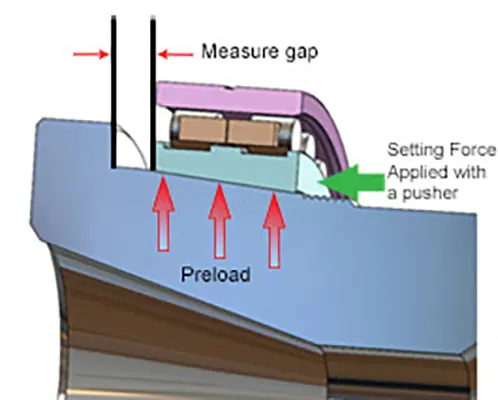
As noted in a previous blog angular contact bearings are preloaded in the axial direction. Cylindrical roller bearings on the other hand are preloaded in the radial direction. The method of setting preload varies significantly depending if the bearing is a straight bore or a tapered bore roller. Setting proper preload on a tapered roller bearing is rather straight forward. It is substantially more difficult on a straight bore bearing and we will only speak about it briefly in this article.
Straight Bore Cylindrical Roller Bearings
Tapered Bore Cylindrical Roller Bearings


Proceed to Part 5: About Capture, Specialty Bearings and Hydraulic Nuts →